What to Do If You Have a low oxygen blue skin baby ? Unlimited Guide
Seeing a low oxygen blue skin baby can easily be one of the most terrifying moments for any parent or caregiver.
It is completely natural to feel a massive rush of panic when you notice a bluish tint on your little one.
But please, take a deep breath. I am here to walk you through exactly what this means in the most straightforward way possible.
We are going to talk about why this happens, what doctors do to help, and how you can stay strong for your child.
Grab a cup of tea, sit back, and let’s dive into everything you need to know about this condition.
What Exactly Does This Bluish Tint Mean?
In the medical world, this bluish discoloration of the skin is known as “cyanosis.”
It simply means that the red blood cells in the body are not carrying enough oxygen to the tissues.
When your blood is rich and full of oxygen, it has a bright, beautiful red color.
This healthy, oxygen-rich blood gives human skin that familiar pinkish, warm, and vibrant glow.
However, when those oxygen levels drop unexpectedly, the blood turns a darker, bluish-red shade.
Through the thin skin of an infant, this darker blood looks blue, purple, or even grayish.
When medical professionals talk about a low oxygen blue skin baby, they are usually looking closely at the lips, tongue, or chest.
Acrocyanosis vs. Central Cyanosis: Knowing the Difference
Before you panic, it is incredibly important to know that not all blue skin is a medical emergency.
There are two main types of cyanosis, and one is actually quite normal for newborns.
The first type is called Acrocyanosis. This is when only the baby’s hands and feet turn blue.
This happens because a newborn’s blood circulation system is still developing and getting used to the outside world.
If your baby’s hands and feet are blue, but their lips and chest are pink, they are likely just a little cold.
The second type is called Central Cyanosis, and this is the one that requires immediate medical attention.
Central cyanosis affects the core of the body, meaning the lips, tongue, head, and torso turn a bluish color.
If you see central cyanosis, it means the vital organs might not be getting the oxygen they need.
Why Does a low oxygen blue skin baby Happen?
The science behind a low oxygen blue skin baby revolves almost entirely around the heart and the lungs.
Your baby’s heart and lungs work together as a team to pump oxygenated blood throughout their tiny body.
The lungs breathe in the fresh air and transfer the oxygen into the bloodstream.
Then, the heart acts as a powerful pump, sending that oxygen-rich blood to the brain, organs, and skin.
If there is a glitch anywhere in this process, the oxygen levels in the blood will inevitably drop.
Sometimes the lungs are struggling to absorb the oxygen from the air around them.
Other times, the heart might have a structural issue that prevents it from pumping the blood effectively.
Understanding this connection is the first step to figuring out how to help your child heal.
Common Causes Behind a low oxygen blue skin baby
There is no single reason why this happens, as several different underlying conditions can trigger it.
Doctors will always run tests to find the exact root cause, but here are the most common culprits.
- Congenital Heart Defects: Some babies are born with structural issues in their heart.
- Tetralogy of Fallot: This is a specific combination of four heart defects that cause “blue baby syndrome.”
- Respiratory Syncytial Virus (RSV): A very common respiratory virus that can severely restrict a baby’s airways.
- Asthma or Bronchitis: Conditions that cause inflammation in the lungs, making it incredibly hard to breathe.
- Pneumonia: A serious infection in the lungs that fills the air sacs with fluid.
- Meconium Aspiration: Sometimes, a baby inhales their first stool during birth, blocking their tiny airways.
- Extreme Cold Exposure: Prolonged exposure to cold temperatures can restrict blood flow to the skin.
As you can see, the causes range from simple environmental factors to complex structural issues.
This is why getting a professional medical diagnosis is absolutely non-negotiable.
Symptoms You Should Never Ignore
Babies cannot tell us when they are feeling unwell, so we have to be exceptional detectives.
Aside from the obvious blue color, there are other warning signs that usually accompany low oxygen levels.
If you notice your baby turning blue, immediately check for any of these following symptoms:
- Grunting Noises: Listen closely to see if your baby is grunting or sighing with every single breath.
- Nostril Flaring: Watch their nose; if the nostrils open wide when breathing in, they are struggling.
- Chest Retractions: Look at their bare chest to see if the skin is sucking in tightly around the ribs.
- Lethargy: An oxygen-deprived baby will be unusually tired, floppy, and hard to wake up.
- Poor Feeding: If your baby is too exhausted to drink milk or feed from the breast, it is a red flag.
- Rapid Breathing: Count their breaths; breathing much faster than normal is a sign of distress.
If you spot the blue tint along with any of these symptoms, do not wait or second-guess yourself.
Call emergency services or rush to the nearest pediatric emergency room right away.
What Happens When You Arrive at the Hospital?
Walking into an emergency room with a sick baby is overwhelming, but knowing what to expect can ease your mind.
The very first thing the doctors and nurses will do is stabilize your little one.
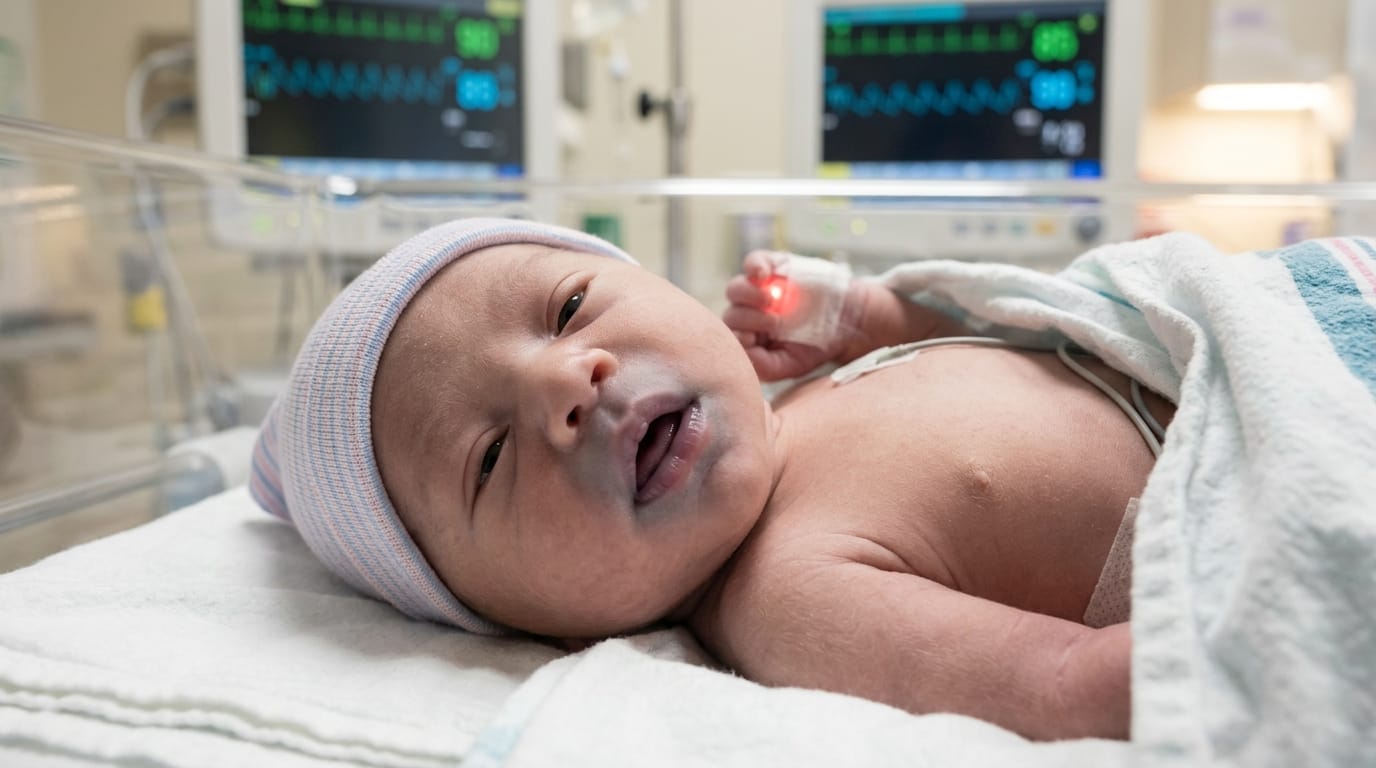
They will likely place a tiny, painless light sensor on your baby’s finger or toe called a pulse oximeter.
This amazing little device instantly measures the exact percentage of oxygen in your baby’s blood.
If the oxygen level is indeed low, they will immediately provide supplemental oxygen.
This might be done through a small tube under the nose, a soft mask, or an oxygen hood.
Once your baby is breathing comfortably and their color starts to return to normal, the detective work begins.
The Medical Tests: Finding the Root Cause
To figure out exactly what is going on, the medical team will need to run a few painless tests.
Do not be alarmed by the machines; they are completely safe and designed to help your child.
Here are the most common diagnostic tests your baby might undergo:
- Chest X-Ray: This gives the doctors a clear picture of the lungs to check for fluid, infection, or pneumonia.
- Echocardiogram (Echo): This is essentially an ultrasound for the heart to look for any structural defects.
- Electrocardiogram (EKG): A quick test that measures the electrical activity and rhythm of your baby’s heart.
- Arterial Blood Gas (ABG): A small blood test that provides highly accurate oxygen and carbon dioxide levels.
- Blood Cultures: If the doctors suspect an infection, they will check the blood for bacteria or viruses.
The doctors will keep you updated every step of the way as the results come in.
Never be afraid to ask the medical staff to explain a test or a result to you a second time.
How to Support a low oxygen blue skin baby at the Hospital
It is easy to feel helpless when your child is in a hospital bed surrounded by monitors.
But as a parent, your presence is actually one of the most powerful healing tools available.
Caring for a low oxygen blue skin baby in a clinical setting requires patience, love, and a calm demeanor.
First, try your hardest to keep your own anxiety in check, because babies can sense your stress.
Speak to them in a soft, soothing, and familiar voice, and gently stroke their head or hold their little hand.
If the doctors allow it, practice skin-to-skin contact, which has been proven to help regulate a baby’s heart rate.
Bring their favorite blanket or a small soft toy from home to make the hospital crib feel less scary.
Lastly, take care of yourself by drinking water and resting, because your baby needs you at your best.
Treatment Options and Modern Medicine
The treatment plan for your baby will depend entirely on what the tests reveal.
The good news is that modern medicine has made incredible advancements in pediatric care.
If the issue is a respiratory infection like RSV or pneumonia, the treatment is usually straightforward.
Your baby might receive antibiotics, antiviral medications, or breathing treatments to open up their airways.
They will stay in the hospital on supplemental oxygen until their lungs are strong enough to work alone.
If the issue turns out to be a congenital heart defect, the path might be a little longer.
Many heart defects require specialized surgeries to repair the tiny valves and chambers.
Pediatric cardiologists are literal miracle workers today, and these surgeries have incredibly high success rates.
Bringing Your Baby Home: Life After the Hospital
The day you get to bring your baby home is a joyous occasion, but it often comes with a bit of anxiety.
It is completely normal to feel hyper-vigilant and nervous once you leave the safety of the hospital monitors.
Your doctors will provide you with a very specific, easy-to-follow discharge plan for home care.
Every low oxygen blue skin baby has a unique journey to recovery, so follow your specific instructions closely.
You might be sent home with a portable pulse oximeter so you can check their levels yourself.
Some babies might even need to come home with a small, portable oxygen tank for a little while.
Make sure your house is completely smoke-free, as secondhand smoke is incredibly dangerous for healing lungs.
Keep your baby away from crowded places and sick relatives until their immune system is fully recovered.
The Emotional Toll: Taking Care of Your Mental Health
We spend so much time talking about the baby’s health that we often forget about the parents.
Going through a medical emergency with your newborn is a deeply traumatic experience.
It is very common for parents to experience symptoms of anxiety, depression, or even PTSD after returning home.
You might find yourself waking up constantly in the night just to watch your baby’s chest rise and fall.
Please know that these feelings are valid, normal, and completely understandable given what you have been through.
However, you do not have to carry this heavy emotional burden all by yourself.
Reach out to a therapist, join an online support group for parents of sick babies, or lean on your close friends.
Remember, taking care of your own mental health is a crucial part of being a great parent.
Empowering Yourself: CPR and First Aid
One of the best ways to combat the lingering anxiety is to empower yourself with knowledge.
Once your baby is settled at home, I highly recommend signing up for an infant CPR class.
Knowing exactly what to do in a worst-case scenario will give you an immense sense of confidence.
These classes will teach you how to perform chest compressions and rescue breaths on a tiny body.
They will also teach you how to safely dislodge an object if your baby is ever choking.
You can usually find these classes at your local hospital, fire station, or community center.
Invite your partner, the baby’s grandparents, and any babysitters to take the course with you.
Creating a safe, prepared environment is the best gift you can give to your growing family.
When to Call the Doctor Again
Even after your baby has been treated and sent home, you must remain observant.
Recovery is not always a perfectly straight line, and sometimes minor setbacks happen.
You should call your pediatrician immediately if your baby starts feeding poorly or seems unusually sleepy again.
Keep an eye out for any mild return of the bluish tint around their mouth during feeding or crying.
If your baby develops a fever, a persistent cough, or seems to be breathing faster than normal, do not wait.
Trust your parental intuition; you know your baby better than anyone else in the world.
If something feels off to you, it is always better to get it checked out and be told everything is fine.
Doctors would much rather see a healthy baby for a false alarm than miss a crucial warning sign.
A Bright and Healthy Future
It is so important to remember that this scary chapter does not define your child’s entire life.
Thanks to the incredible dedication of medical professionals, most babies make a full and wonderful recovery.
Children who have faced these early challenges often grow up to be happy, healthy, and incredibly resilient kids.
They run, they play, they go to school, and they live completely normal, beautiful lives.
You will get through this difficult season, and one day, it will just be a memory of how strong your family is.
Celebrate every small victory, from a good feeding session to a full night of peaceful sleep.
You are doing an amazing job advocating for your child, and they are so lucky to have you.
Conclusion
Navigating the scary reality of infant health emergencies is incredibly daunting, but you are never alone in this journey. Whether it is a mild case of cold hands or a more serious condition requiring hospital care, understanding the signs and symptoms is your greatest superpower. Always remember that prompt medical attention, a calm mindset, and endless love are the best tools you have to help your little one heal and thrive.