Skip hop baby activity center review
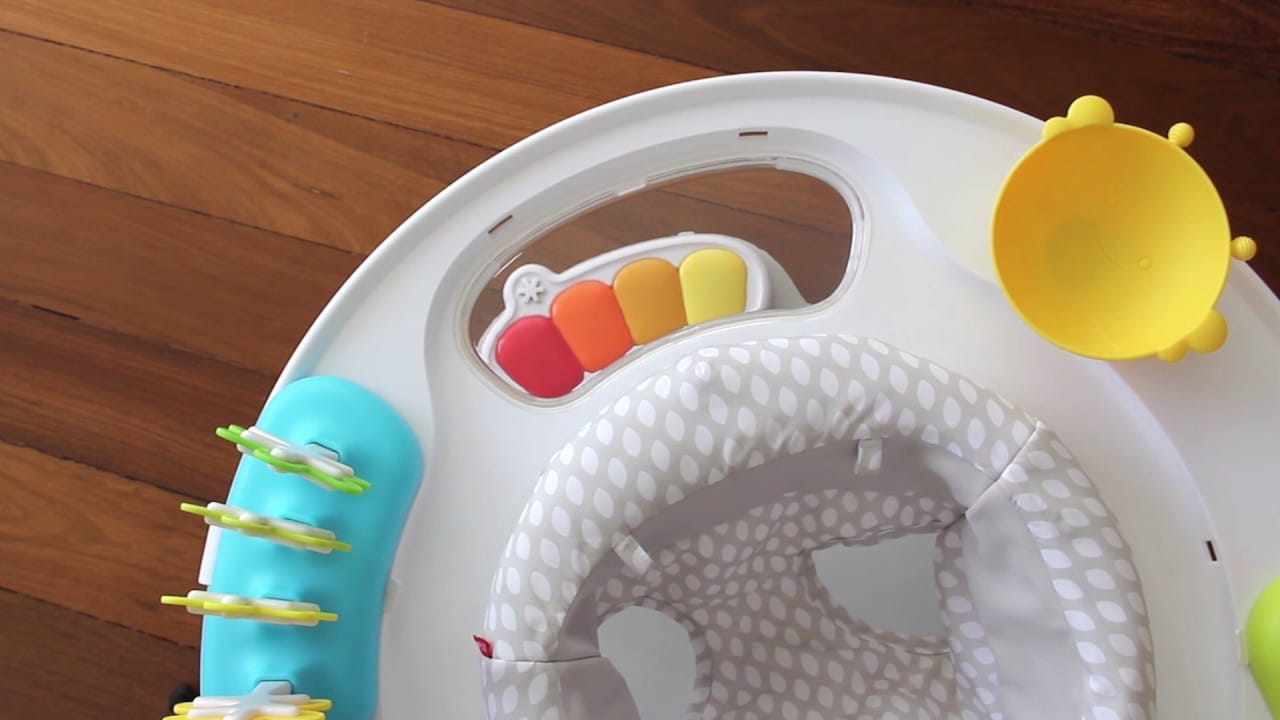
If you’re reading a skip hop baby activity center review, you’re probably weighing whether a premium entertainer is worth the spend when a basic saucer might do the job. This isn’t just a count of toys and color options. It’s about whether a product that looks beautiful in curated nursery photos can survive teething drool, snack crumbs, and a toddler who treats every surface like a launchpad.
The Skip Hop Explore & More Baby’s View 3-Stage Activity Center meets the ASTM F1235 safety standard and is JPMA certified. As of 2026, it usually sells between $140 and $160, putting it in the upper tier of stationary entertainers. We combed through hundreds of verified buyer experiences and manufacturer specs to tease out where this activity center genuinely delivers and where the design stumbles.
Image source: YouTube / SkipHopNYC (YouTube thumbnail (fair-use with source credit))
Quick Answer
The Skip Hop Baby’s View Activity Center converts from a baby seat to a toddler play table. It packs over 25 developmental activities and a 360-degree rotating seat. Most families say it’s a stylish, long-lasting entertainer.
The foot piano encourages cause-and-effect learning but frustrates with inconsistent sensitivity. Common gripes include a finicky table hole cover and tricky crevice cleanup. It earns its price tag if you want a modern, grow-with-me design that skips the jumperoo bounce.
The 3 Stages Explained: How the “Grow-With-Me” Promise Actually Plays Out
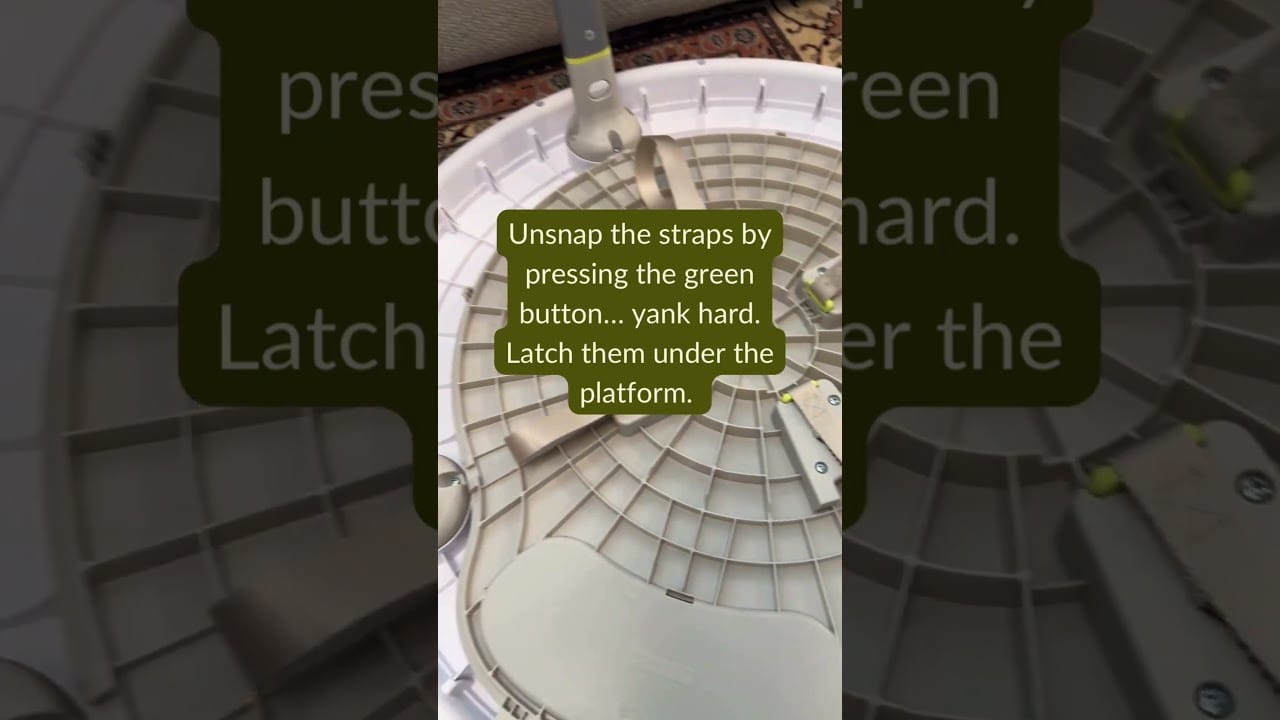
Image source: YouTube / Chestnut House (YouTube thumbnail (fair-use with source credit))
Skip Hop designed this activity center around three distinct modes that follow your child from sitting to standing, then to independent play. That’s a smart idea on paper. In practice, each stage brings a mix of clever engineering and real-life friction.
Stage 1: Baby Seat with Bounce, Swivel, and Foot Piano
This is the mode you’ll use first and longest, typically from around 4 months until your baby can walk or hits the 25-pound, 30-inch limit. The seat clips onto a rotating arm that lets your baby swivel 360 degrees to reach every toy without you having to reposition them. A gentle bounce comes from the seat’s own springiness, not from suspended jumperoo straps.
The integrated foot piano is the standout feature. When your baby kicks the large piano keys, lights flash and cheerful sounds play, creating a cause-and-effect loop that encourages leg strength and coordination. Three height positions let you adjust the seat as your child grows, and the machine-washable pad pops off for cleaning after inevitable blowouts.
What parents notice right away is the sheer number of activities. You get a clacker, a bead mover, a flower mirror, a rattle bee, and several clip-on hanging toys. Everything is BPA-free, phthalate-free, and PVC-free, which matters when every toy ends up in a mouth.
Stage 2: Cruise-and-Play Without the Seat
Once your little one starts pulling up to stand, you remove the seat entirely. The outer rim becomes a sturdy cruise bar, and the activity center turns into a stationary exploration station. Your child can shuffle around the 360-degree play surface, batting at the same toys they sat inside just weeks earlier.
This isn’t a walker. The base stays put. That’s actually a good thing, because stationary entertainers avoid the safety concerns tied to mobile walkers, which the AAP advises against.
The cruise stage usually works best between about 9 and 14 months, though some tall kids outgrow it faster if they’re already ready to roam.
The biggest downside here is that the toys remain fixed at tabletop height. A cruising baby might lose interest more quickly than a seated baby did, especially if they want to crawl away and explore. Still, it buys you several extra months of use before the final transformation.
Stage 3: A Toddler Play Table (And That Tricky Center Hole)
Remove the seat mechanism and the toy bar, snap in a flat cover plate, and the activity center becomes an open play table. Toddlers can stand or sit at it for snacks, puzzles, and crafts. The table height is fixed, so it works best for kids in the 12- to 24-month range, though older toddlers might find it a little low.
Here’s where things get tricky. The seat removal leaves a large hole in the center of the table. If you don’t plug that hole, a curious child could get their head or body stuck.
Skip Hop sells a chalkboard cover plate separately, and some later editions include a flat plastic cover in the box. Always check that your version has a proper cover before switching to table mode. If it doesn’t, you’ll need to buy one or you can’t safely use this stage.
The table surface is smooth and easy to wipe down, and the wood-look legs hold up to moderate toddler use. It’s not a heavyweight art table, but it fills a real need for families short on floor space who don’t want to store a single-purpose entertainer when baby stage ends.
What Living With This Activity Center Is Actually Like
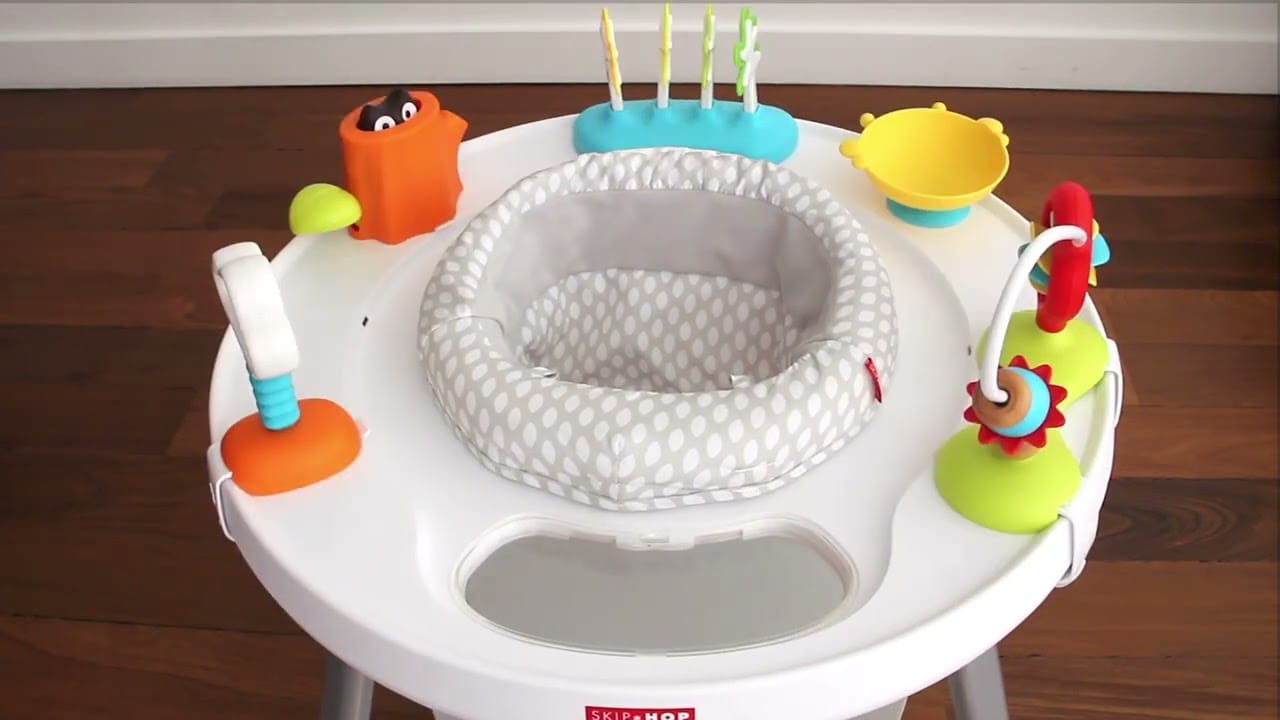
Image source: YouTube / duckduckbaby (YouTube thumbnail (fair-use with source credit))
Even a well-designed product reveals its quirks once it’s been through months of real-life use. Here’s what verified buyers consistently report.
The Seat and Swivel: Smooth Spins or Stiff Turns?
The 360-degree rotation is one of the biggest selling points. When it works well, your baby glides effortlessly from the bead mover to the mirror, keeping engagement high without any help from you. Many parents say the swivel motion is smooth right out of the box.
Others report that the rotation grows stiff after a few months of use, especially if crumbs or dust collect in the rotating hub. A stiff swivel frustrates babies who can’t reach the toy they want, leading to short play sessions and crankiness. The fix usually involves taking the seat assembly apart and cleaning the track, something that’s not obvious in the quick-start guide.
The seat pad itself gets mixed reviews on comfort. It’s thin by design, which makes it easy to wash and quick to dry. Some babies are perfectly content in it.
Others, particularly chunky-thighed kiddos, seem to fuss after 10 or 15 minutes. There’s no plush padding, so you may need to adjust expectations if your baby is used to a softer bouncer.
The Foot Piano: Brilliant Idea, Frustrating Execution
No feature sparks more debate than the foot piano. When it works, it’s magic. Your baby kicks, lights blink, happy tunes play, and you get a few minutes to drink your coffee.
The sensor is supposed to detect pressure across the entire piano surface.
In the real world, the sensitivity can be inconsistent. Some units respond only to firm stomps on the center of the keys. If your baby taps lightly with their toes on the edge, nothing happens.
That inconsistency confuses little ones and short-circuits the cause-and-effect learning the piano is meant to teach. Hard floors sometimes help, because the sensor reads pressure more reliably against a firm surface. On thick carpet, you might need to place a board underneath.
Battery life is another consideration. The piano needs three AA batteries, which aren’t included. You’ll also need a small screwdriver to open the battery compartment, which isn’t sealed against moisture.
If a sippy cup tips over near the foot area, moisture can sneak in and corrode the contacts. Several reviewers note that their piano stopped working after a spill and needed a thorough cleaning to revive.
Toy Bar Cleanup and Other Daily Gripes
Most of the toys are fixed to the outer ring, which means you can’t toss them in the dishwasher. You’ll be wiping down crevices by hand, and those crevices are deep. The bead mover, the clacker, and the flower mirror all trap crumbs, drool, and the occasional blob of puréed carrot.
A damp cloth reaches the surface, but getting into the tight spots takes a toothbrush or a tiny bottle brush.
The clip-on hanging toys are easier. You can remove them, rinse them in the sink, and clip them back on. The seat pad machine-washes beautifully and dries fast, which is a genuine plus.
The plastic legs and foot pads wipe clean with a spray of mild cleaner.
A final grumble worth mentioning is assembly. The instructions rely heavily on diagrams, and some parents find the leg attachment step confusing. The legs screw in without tools, but they need to be aligned just right, and the locking mechanism sometimes feels stubborn.
Once built, the unit is stable and sturdy. Getting there, though, can take a cup of patience.
Skip Hop vs. Fisher-Price and ExerSaucer: Where It Shines and Falls Short
Comparing the Skip Hop Baby’s View to its main rivals helps clarify where that extra $40 to $60 goes and what you give up.
Skip Hop Baby’s View vs. Fisher-Price 3-in-1 Sit-to-Stand
The Fisher-Price 3-in-1 Sit-to-Stand transforms from seated entertainer to cruise station to toddler table, just like the Skip Hop. The Fisher-Price model often comes in at a lower price, around $90 to $120 as of 2026. It has a spinning seat with a bouncy spring action, not a swivel arm, and it lacks the foot piano.
The toys tend to be bulkier and more plastic-looking, with bright, primary colors that scream “toy.”
Skip Hop wins on aesthetics and floor footprint. The Baby’s View is trimmer at 28.5 inches across, while the Fisher-Price model needs closer to 32 inches. Fisher-Price edges ahead on sheer bounce intensity and the lower sticker price.
If you care about your living room not looking like a daycare, go Skip Hop. If you just want raw entertainment value for less money, the Fisher-Price is a solid bet.
Skip Hop Baby’s View vs. Fisher-Price Rainforest Jumperoo
This isn’t a direct stage-for-stage comparison because the Rainforest Jumperoo is a single-mode jumper with no table conversion. It retails around $100 to $130 and gives your baby a suspended, high-bouncing workout that the Skip Hop can’t touch. Jumperoos are fantastic for burning energy, and some babies adore the frantic bouncing motion.
The trade-off is lifespan. Once your baby exceeds the Jumperoo’s 25-pound weight limit or starts trying to climb out, you’re done. The Skip Hop transitions into two additional modes that can last into toddlerhood.
If you have a high-energy bouncer who needs the jumper action and you’re fine buying a separate play table later, the Jumperoo makes sense. If you want one purchase to last several years, the Skip Hop wins.
Skip Hop vs. Evenflo ExerSaucer Bounce & Learn
Evenflo’s ExerSaucer Bounce & Learn is a classic stationary entertainer with a bouncing seat and a generous spread of toys. It’s priced in the $90 to $120 range, and the bounce comes from springs under the seat, similar to the Fisher-Price design. Some Evenflo models offer a cruise-around mode, but they don’t convert to a true flat play table the way the Skip Hop does.
The Evenflo tends to have a larger toy selection and a bigger bounce, but it’s bulky and tough to blend into a living space. The Skip Hop again wins on footprint, looks, and multi-stage longevity. The Evenflo becomes a storage headache once your child outgrows it, while the Skip Hop earns its keep as a table for another year or two.
Side-by-Side Comparison Table
| Product | Price (as of 2026) | Stages | Bounce Style | Footprint (approx.) |
|---|---|---|---|---|
| Skip Hop Baby’s View 3-Stage Activity Center | $140–$160 | 3 (seat, cruise, table) | Seat spring bounce + swivel, foot piano | 28.5” × 28.5” |
| Fisher-Price 3-in-1 Sit-to-Stand Activity Center | $90–$120 | 3 (seat, cruise, table) | Seat spring bounce + spin | ~32” diameter |
| Fisher-Price Rainforest Jumperoo | $100–$130 | 1 (jumper only) | Suspended jumper bounce | ~36” diameter |
| Evenflo ExerSaucer Bounce & Learn | $90–$120 | 1 (seat, some with cruise) | Seat spring bounce | ~34” diameter |
Who Should Buy It — and Who Should Walk Away
If you’re the kind of parent who thinks hard about how a piece of baby gear meshes with your home’s look, this activity center is built for you. The wood-look legs and muted toy palette aren’t an accident. Skip Hop clearly designed this to sit in a living room without shouting “plastic baby containment device” at every guest.
It’s also a strong pick if you’re short on storage space. You get three stages of use from one floor-hogging item, which means you aren’t tripping over a garish jumperoo and a separate toddler table a year later. The 360-degree swivel and foot piano give it a developmental edge over basic saucers, assuming both features work reliably in your unit.
You should walk away if your baby is a serious bouncing enthusiast who lives for the airborne thrill of a jumperoo. The Skip Hop’s gentle bounce won’t satisfy that need, and you’ll end up buying a jumper anyway. Skip it too if your child is already approaching the 30-inch height or 25-pound weight limit, because you won’t get enough seat time to justify the cost.
If you know you’ll skip the cover plate and leave a gaping hole in the table stage, don’t buy this product. That’s a real safety risk, and it’s not something to gamble on. Finally, if cleaning tight toy crevices with a toothbrush sounds like your personal nightmare, the fixed toy bar might drive you up the wall.
Safety Realities: Weight Limits, Entrapment Risks, and That Table Hole
The Skip Hop Baby’s View meets the ASTM F1235 standard for stationary activity centers. It’s JPMA certified. As of 2026, the CPSC has no active recalls for this model.
That’s reassuring, but safe use depends on you following a few non-negotiable rules.
Stop using the seat the moment your child weighs 25 pounds, reaches 30 inches tall, or can walk. Even if your baby looks secure, a walking-ready kid can tip themselves out. The base sits flat and wide, so the unit won’t topple easily on a level floor.
It is not for use on elevated surfaces. Never place it on a table, bed, or counter.
The biggest lingering safety concern is the table hole in stage 3. After removing the seat, you’re left with a large open center. A toddler can climb underneath and trap their head or neck.
The fix is simple: plug that hole with the cover plate included in some editions, or buy Skip Hop’s chalkboard insert separately. Check your box contents before assembling the table stage. If no cover came in yours, order one.
Don’t skip this step.
What You’ll Actually Pay (And If It’s a Good Value)
The Baby’s View typically lands between $140 and $160 at major retailers as of 2026. That’s $30 to $50 more than a Fisher-Price 3-in-1 and about $10 to $20 more than an Evenflo ExerSaucer Bounce & Learn. The extra spend buys you the 360-degree swivel, the foot piano, and the modern aesthetic that looks intentional in a living room.
Is it a good value? If you use all three stages, absolutely. You’d pay at least $40 for a decent toddler play table alone, so building that into the same product offsets the upfront cost.
Factor in the space you save by not storing multiple pieces of gear, and the math tilts further in Skip Hop’s favor.
Where value gets shaky is if your baby loathes the seat or outgrows it by 8 months. In that scenario, you’ve paid for stages you won’t reach, and a budget entertainer would have done the same job for less. Also, if you skip the table cover plate, the third stage becomes a safety hazard rather than a usable feature.
That erases part of the value proposition entirely.
Setup, Batteries, and Keeping It Clean: The Stuff the Manual Skips
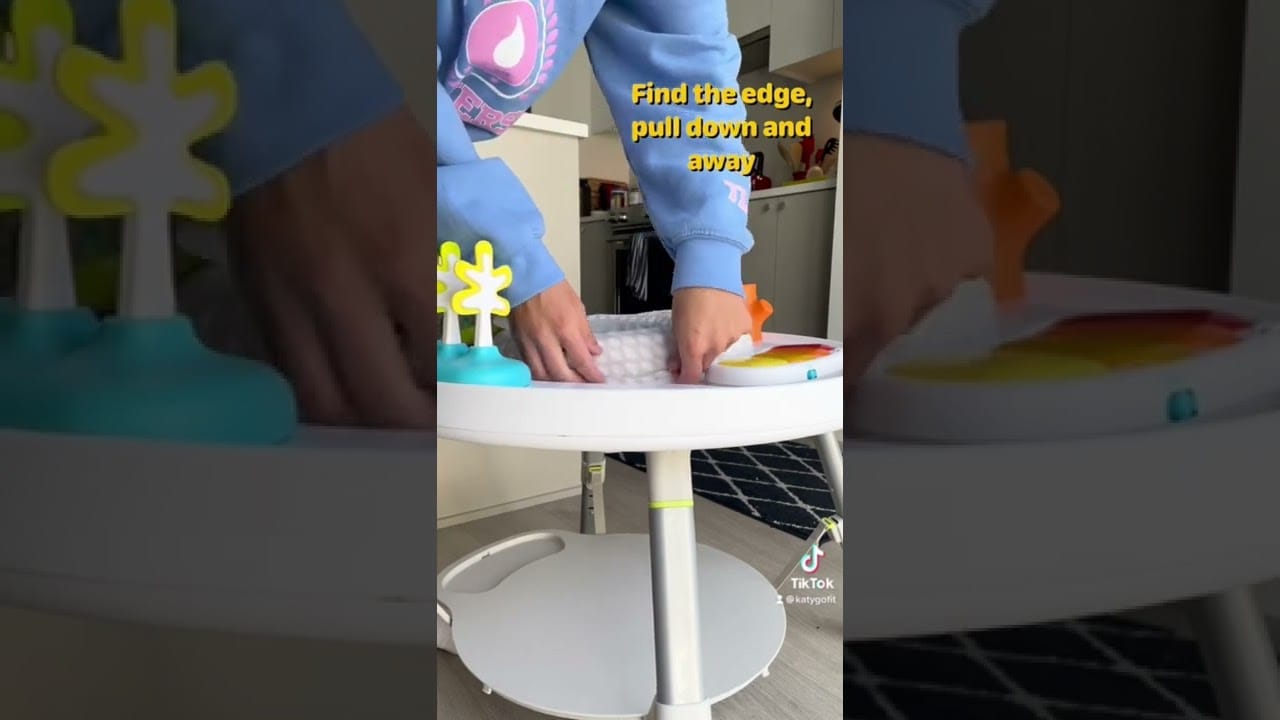
Image source: YouTube / Katygofit (YouTube thumbnail (fair-use with source credit))
Assembly doesn’t need tools, but the legs demand patience. Line them up carefully before twisting. The locking tabs can feel stiff.
Push firmly until you hear a distinct click on all four legs. Skipping that click leads to wobbling.
The foot piano requires three AA batteries, not included. You’ll need a small Phillips screwdriver to open the battery compartment. Keep moisture far away from that compartment.
Spills near the foot area can corrode the contacts fast. If the piano becomes unresponsive, dry it out and clean the terminals with a cotton swab before assuming it’s dead.
Daily cleaning is mostly wiping. The seat pad pulls off and washes beautifully in a cold machine cycle. Air-dry it.
Don’t put it in the dryer. The plastic toy bar traps gunk in hard-to-reach crevices. A soft toothbrush and mild soap get those spots clean.
For the table surface, a damp microfiber cloth handles snack residue quickly. Skip Hop’s official product care guidance recommends spot-cleaning the hanging toys and inspecting the seat attachment clip regularly for wear.
“My Baby Hated the Seat” — When the Activity Center Flops and What to Try
Some babies take one look at the seat and decide it’s a tiny prison. If your child screams or arches out after two minutes, don’t force it. A handful of verified buyer stories start with a week of rejection and end with the baby loving it once their feet could reach the piano properly.
Before you return the box, try lowering the seat to its lowest position. Short legs that dangle are uncomfortable, and the foot piano loses its appeal if your baby can’t kick it reliably.
Another common fix is distraction. Put your baby in when they’re already in a good mood, not tired or hungry. Clip a favorite high-contrast toy onto the ring.
Sometimes it takes three or four short five-minute sessions before the activity center becomes normal territory.
If none of that works after a couple of weeks, your baby might simply want motion. The Skip Hop doesn’t bounce with jumperoo intensity. Traders who end up with a bounce-craving kid often swap to a floor-based jumper.
That’s a valid call. No amount of foot piano music will compensate for a baby who really wants to fling themselves upward.
Frequently Asked Questions
How long does setup take from box to ready?
Expect 20 to 35 minutes. No tools are needed. The leg attachment step is the slowest part.
Once built, you can switch between stage configurations in under 5 minutes.
What are the exact age, height, and weight limits for the seat?
The seat is designed for babies from about 4 months until they can walk or stand unassisted, reach 25 pounds, or hit 30 inches. Stop using the seat immediately once any of those thresholds is crossed.
Can the Skip Hop Baby’s View replace a jumperoo?
It cannot if your baby craves a suspended bouncing motion. The Skip Hop offers a gentle bounce from the seat’s springiness, not the free-hanging jumper action. It’s a stationary entertainer, not a jumper.
Does Skip Hop sell the table cover plate separately?
Yes. If your box didn’t include a cover plate, you can buy the Skip Hop chalkboard insert separately. It fits the center hole and converts it into a usable drawing surface.
Never use the table stage without a plug in place.
Has this activity center ever been recalled?
No. As of 2026, the CPSC database shows no active or past recalls for the Skip Hop Explore & More Baby’s View 3-Stage Activity Center. It is currently compliant with ASTM F1235 and JPMA certification requirements.
Is the foot piano loud enough to bother neighbors?
It’s cheerful but not unusually loud. Volume is fixed. If you’re in an apartment with thin floors, place a dense rug pad underneath to absorb sound.
Some parents report that the piano’s chime carries less than the toy clatter.
Final Verdict: Buy the Skip Hop Activity Center If…
You want one piece of gear that looks good, saves floor space, and genuinely grows with your child through three useful stages. Buy it if aesthetics matter to you and your baby is content with a gentle bounce rather than a suspended jumper workout. Buy it if you're willing to track down the cover plate and scrub a few toy crevices with a toothbrush now and then.
Skip it if your kid lives for high-intensity bouncing or is already nudging the 25-pound, 30-inch ceiling. Skip it if you'll never bother converting it to a table. For the right household, this is a smart, long-lasting purchase that earns its price tag.
For everyone else, a basic saucer and a separate play table will serve just fine.